

Individual Therapy for Relationships in Colorado Springs
Recently I stayed in an Airbnb that had a framed sign hanging over the toilet that said in big, bold letters…
DO NOT LEAVE BATHROOM UNTIL TOILET STOPS RUNNING!!!
That’s it. No explanation, no next steps… just an order to stay with the toilet as long as it was running.
We all joked that it was so stressful. I mean, what are we supposed to do if it doesn’t stop running???
Shortly after checking out of the airbnb (I’m pleased and relieved to report that the toilet did, in fact, stop running each time so we never had to figure out what to do if it didn’t…) I stopped at a gas station that had these signs taped ALL OVER the wall by the sink…
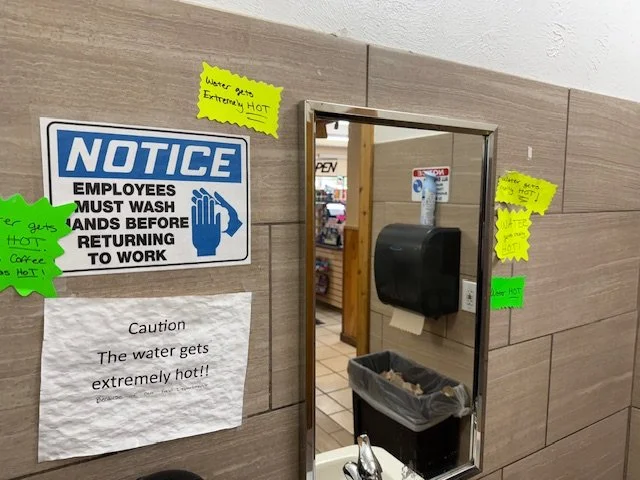
If you can’t see clearly, there were more than six different signs advising caution due to very hot water. Again, I had the feeling that I’m being given so much responsibility when I’m just trying to take care of my business. A sense of…
It’s not even my toilet (or sink) - you should be responsible for fixing your own toilet (and sink) instead of making me responsible for managing the problems of your broken toilet (/sink)…
Okay, so I think in metaphors, and this all made me a think a lot about codependency - an unhealthy relational pattern in which one person is controlled by the needs or problems (usually addiction or mental health issues) of another. Codependent patterns and relationships are often what drives someone - typically the codependent person managing all of the responsibility in the relationship - to seek therapy.
A lot of people end up in therapy because they’re managing the problems of others in their lives
People in their lives with addictions, untreated mental health issues, a pattern of making poor or irresponsible choices, controlling or manipulative personality tendencies… People who aren’t fixing their own toilets, if you will. My clients are often stuck in codependent or out of control patterns, picking up too much responsibility for problems that don’t belong to them.
It’s hard to break codependent patterns because it’s those very patterns that often feel like they’re holding life together by a thread. If a loved one is caught in an addiction and you don’t try to keep them from using, monitor their whereabouts, and control their behavior, then what? If someone in your life has an untreated mental health issue that means they don’t take care of their responsibilities reliably, what can go wrong if you don’t pick up all the slack and take care of your responsibilities and theirs? If you’re in a relationship with someone who is prone to rage and controlling behavior, how overwhelming is your life going to get if you don’t work to manage their reactions?
You’ve probably found out the answers to these questions in the past and only know at this point you don’t want to go through all of that again. There’s so much anxiety that lives alongside codependency, and that keeps it going. It’s metaphorically like being trapped in a bathroom with a running toilet and a big mess you’re not allowed to leave - it feels out of control, and there’s a sense of panic around what could happen next and what will happen to you if it does.
There are simple steps you can take to get out of codependent patterns and restore balance
It’s not easy, and it can feel threathening at first - but there’s so much peace on the other side of breaking these patterns and feeling back in control of yourself and your life. In therapy, I break it down into 3 simple steps that bring clarity and confidence, that I call ABC: radical Acceptance; building good Boundaries; Creating more life around the problem.
Radical Acceptance
Radical acceptance is the complete acknowledgement of reality as it is, even when it’s not what you want. It’s about facing what you can’t change without continuing to fight so hard to change it. It’s seeing what is happening instead of what you wish would happen. It’s no longer trying to control the things that are out of your control - mostly the other person and their choices. It’s not an acceptance of what’s happening that’s wrong, but it is the choice to fully accept the reality of what’s actually happening in the present moment.
Yes, this radical level of acceptance can be painful. It may come with grief - but it also comes with relief. When you stop giving all of your energy to controlling what you didn’t start and can’t fix, you free up energy to cope, find clarity, and choose your own best course of action moving forward.
Build Boundaries
Figuring out how and where to set boundaries is hard, there’s no formula - but it’s pretty amazing how much easier it feels once there’s an acceptance of the true reality of the situation.
The next step is to identify behaviors in the other person that are no longer acceptable to you. It helps to make a list, and if you’re not sure, good clues to follow are noticing any time you feel anxious, out of control, angry, or resentful due to their destructive choices or behaviors - these are all signals that a line is being crossed somewhere, and your emotions are crying out for a boundary that protects you.
That brings you to figuring out what the boundary should be and how to best communicate it. This can feel challenging, and support in therapy can help. One thing to know is that your boundaries are flexible, not forever - if needed, you can tighten them up, and if things are improving, you can loosen them a bit.
Create More Life Around the Problem
You really can’t change another person. They can only change themselves when and if they’re ready, and you can only control yourself and your responses in the meantime.
As long as the other person is repeating the same patterns, there may exist an almost black hole of pain in your life. Maybe you can’t fill that hole or make it smaller because they won’t change - but you can make life bigger around it…
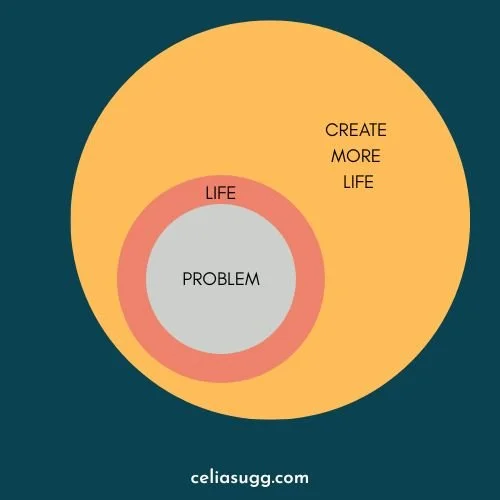
What things outside of this relationship can you put energy into that are life-enhancing instead of soul-sucking?
A good friendship? A hobby or activity that brings you joy? A spiritual practice? Find those things and invest in them to balance out the problems that are out of your control.
The problem may not get smaller, but making life bigger around the problem can still change how it feels.
You can get back to taking care of your own business - taking responsibility for what’s yours and returning responsibility where you’re carrying too much
This letting go of what’s not yours to carry or fix is scary. Because what if the other person doesn’t change? To be real, they may not. But it opens the possibility. Sometimes in the face of boundaries, people are required to take responsibility for their own problems and things change. Sometimes things get worse before they get better. But sometimes they do get better.
You’ll never know if you keep fixing toilets that aren’t yours.
