
How to Stay in Your Window of Tolerance During EMDR Intensives

EMDR Intensive Therapy in Colorado
Last week I had coffee with a colleague, and while talking excitedly about the powerful impact of EMDR Intensives she asked me an important question…
“How do you keep people in a Window of Tolerance during long EMDR sessions and short-term trauma therapy?”
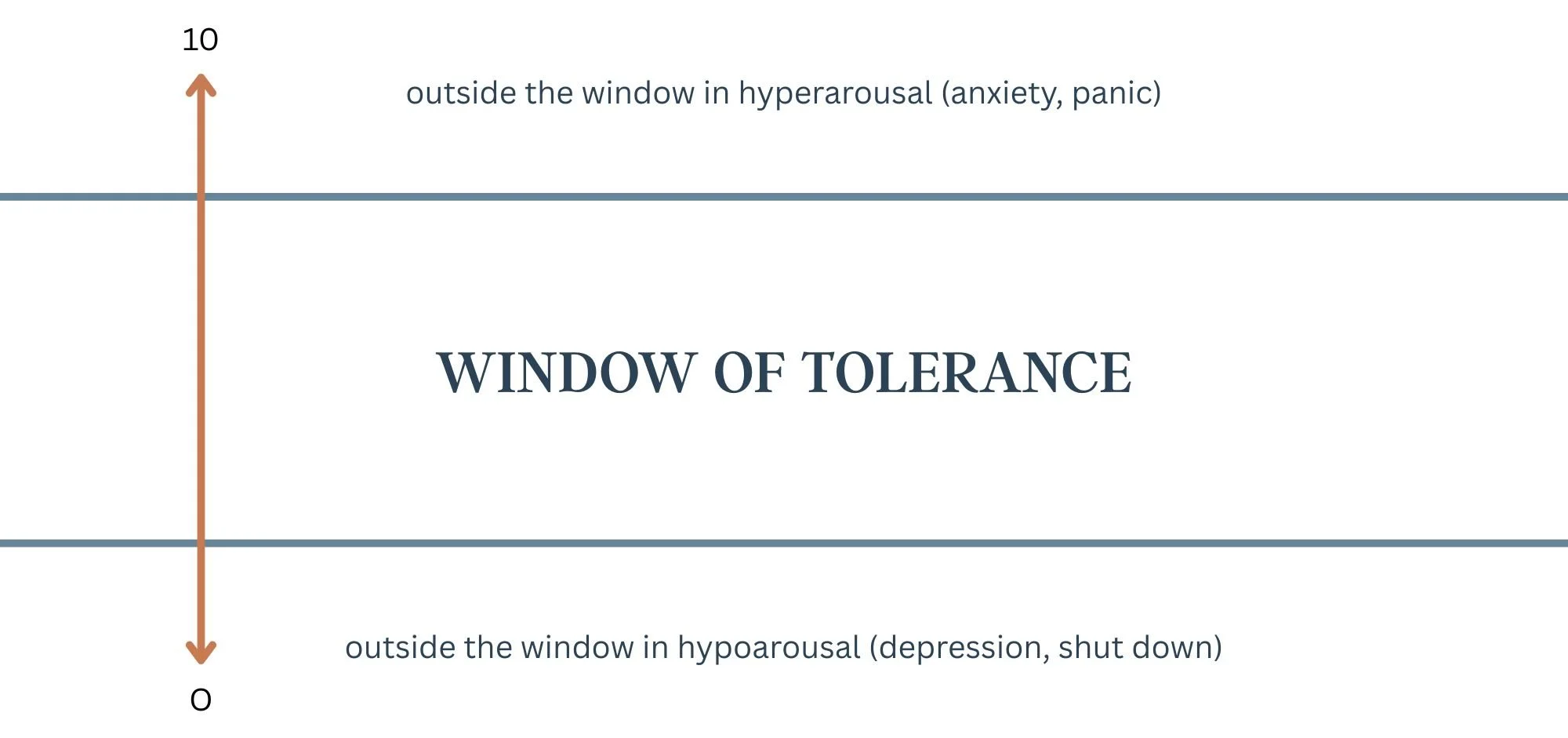
“Window of Tolerance” is a concept that describes a state of optimal functioning - not too low in a state of depressed hypoarousal, and not too high in anxious hyperarousal
If you picture a scale between 1 and 10, in day to day life you ideally want to be somewhere above a 1 but below a 10. In EMDR processing we start with a series of questions that access the memory we’re working with and associated feelings so that you move higher within that window, but we also put what I call “guardrails” in place to make sure you don’t go past the top line of the window - you should never feel outside of the Window of Tolerance during EMDR processing.
EMDR & the Window of Tolerance
My answer to my colleague was that I use three primary ways of ensuring the work stays within a Window of Tolerance during the EMDR Intensive process.
First, preliminary screening helps us ensure that your nervous system is ready for extended processing sessions and short-term work
Intensives aren’t the right fit for every person and every problem, and from our first contact I’m starting to assess if this format is the right fit for you. It’s not good for either of us to go through the Intensive process if it seems it will take you out of your individual “Window of Tolerance,” and I will tell you upfront if I believe a different approach would work better for your needs.
There are 3 ways I screen for fit before deciding on an intensive…
First, in an initial free consult I get an overview of your goals, what you’re wanting to process, and what life looks like currently. This first contact is usually enough to determine if an Intensive is a good fit, but to be on the safe side our next step is to schedule a stand-alone intake session before you commit to an Intensive.
Second, our intake session gives us more time to meet face to face, go through a through review of your history, and make a concrete plan for what we’re going to process and what outcome we’re aiming to achieve. This time to go deeper allows us both to feel confident that an Intensive is the right format for your goals, and that we’re able to work together comfortably.
And finally, the use of screening tools like the Dissociative Experiences Scale (DES), inventories that look at current levels of depression and anxiety, and the Adult Attachment Interview give me a good picture of resources you have in place that will help facilitate EMDR, any potential obstacles that may interfere with progress, and preparation needed before we begin reprocessing.
Second, thorough preparation before starting EMDR can make all the difference between a positive and negative experience
EMDR is an 8 phase process, and reprocessing isn’t intended to start until Phase 3. Phases 1 and 2 involve understanding history, building therapeutic relationship, and developing resources and coping skills to maintain that “Window of Tolerance.” Most of what goes wrong in EMDR happens when this preparation phase is rushed, inadequate, or doesn’t happen at all.
We prepare for your intensive in two main ways…
First, a pre-intensive workbook helps you to share a wealth of information that may ordinarily take us 4-6 sessions to uncover, and gives me a chance to review it and assess what’s needed before we even get started. At times clients find that the workbook is therapeutic in itself and helps them feel more ready for EMDR.
Second, we meet for a pre-intensive preparation session so that you can learn exactly how EMDR works, experience Bilateral Stimulation (BLS - eye movements, tactile, or tapping), and practice using positive resources and visualization before ever opening up trauma memories. This gives you a chance to become comfortable with the process, and for us to both see how you’re likely to respond.
On a side note - if we determine that the short-term, extended processing format of an Intensive is not right for you, it doesn’t mean you can’t ever do EMDR. EMDR can work for most people, sometimes there is just a need for more time in this preparation phase to ensure stability and readiness for the work of reprocessing trauma.
Third, putting “guardrails” for safety in place helps us stay within your individual Window of Tolerance during EMDR
Every person is different, and so is everyone’s individual Window of Tolerance… in fact, your Window of Tolerance may even vary from day to day! To make sure we stay within it, we need to know where those limits sit each time we meet.
A few guardrails that ensure safety once we start reprocessing…
First, we check in to see where the upper limit of your Window of Tolerance is at the time of our reprocessing sessions. If you tell me, “Today I can go to a 7 out of 10,” then we have a clear gauge of how much is too much. EMDR asks you to rate how you’re feeling on a 0-10 scale from time to time, so we’re able to actively check in on your Window throughout processing, making sure that we’re working within it.
Second, we identify a metaphor that helps you watch the memory as an observer rather than feeling like you’re getting sucked into the experience of reliving it. A few examples of a metaphor are:
watching the “scenery” of the memory pass by through a train window
projecting the scene onto a movie screen you can watch play out
using the control of a car window to lower it and let more of the memory in or raise it and keep more of the memory out
visualizing a remote control or dimmer switch that can change the intensity of what you’re observing
The use of a metaphor gives enough observational distance to stay within the Window of Tolerance and observe the memory as something from the past, without having to experience it as though it’s happening in the present.
And third, we start slow. Using bilateral stimulation activates connections in the brain that put reprocessing in motion. Starting out with long sets, at full speed, is like learning to drive for the first time on the interstate - too much, too soon. Starting with shorter sets allows you to slowly connect with the memory and only increase BLS once we both know you’re comfortable and ready to access more of the memory.
The Intensive process provides a positive way to stay within the Window of Tolerance
Even though longer sessions and shorter term trauma therapy can feel like a lot of work, the Intensive process can actually reduce a lot of the overwhelm that often comes with EMDR.
Having more time to process a memory gives us the ability to pace ourselves, slow down when we need to, and still finish reprocessing of a memory within one session. Much of the overwhelm that people experience with EMDR comes after incomplete sessions, when a memory has been opened but not reprocessed to completion, so more of the associated feelings are at the surface until the next session. Once we finish processing a memory, it feels better, more neutral, and you start to notice subtle changes in day to day life.
Longer EMDR sessions allow things to feel better by the time we end. Shorter term trauma work allows life to move forward more quickly.
