
Scapegoats & Black Sheep: How EMDR Can Help if You Were Always the One to Blame

EMDR Therapy & Intensives in Colorado Springs
This post is part of my series, The Common Threads in EMDR Intensives, where I explore the patterns I see in the people who thrive in this format of therapy.
Have you ever felt like no matter what you do, you’re the one who gets blamed?
Maybe your siblings could make mistakes that were overlooked while yours became evidence that you were "the problem." Maybe you were criticized more harshly, held to a different standard, or left wondering why you never seemed to belong in your own family.
People often show up in my office for high anxiety, panic, deeply felt inadequacy, and struggles to feel secure in their relationships. There is often a common underlying pattern behind these symptoms, a history of growing up in a family where they were…
always the one to blame
on the receiving end of constant criticism and shame
never able to do enough to be accepted
They have a deep sense of being the “black sheep” of the family, the one always on the outside and never good enough to just be accepted for who they are. They have often grown up in the role of the “scapegoat” in their family and are struggling with day to day symptoms - anxiety, panic, low self-worth - that reflect the trauma impact of living in this dynamic over time.
What is a family scapegoat?
If you've always felt like you were the one who got blamed more than your siblings, were criticized more harshly, were expected to "keep the peace," or somehow became responsible for everyone else's emotions, you may have been cast in the role of the family scapegoat. It's less about who you are and more about the role you were assigned within your family.
A family scapegoat is the person who is consistently blamed for problems within the family, even when they are not responsible. They often become the "identified problem," while deeper issues in the family go unaddressed. Over time, the scapegoat may come to believe they really are too sensitive, too difficult, or somehow fundamentally flawed, even when they have simply been reacting to an unhealthy family dynamic.
One of the hardest parts of being the family scapegoat is that the role often feels so normal that people don't recognize it until adulthood. Many come to therapy believing they are the problem, when in reality they've spent years carrying a role that never truly belonged to them. While family scapegoats can emerge in many different kinds of dysfunctional families, one of the most common and well-recognized patterns occurs within narcissistic family systems.
What is a narcissistic family system?
First let’s just acknowledge that the word “narcissist” has become incredibly overused. It is often applied to behaviors that are dysfunctional or difficult, but not necessarily narcissistic in a diagnostic sense. I think of narcissistic personality traits as existing on a spectrum: on one end is defenses and on the other end is disorder.
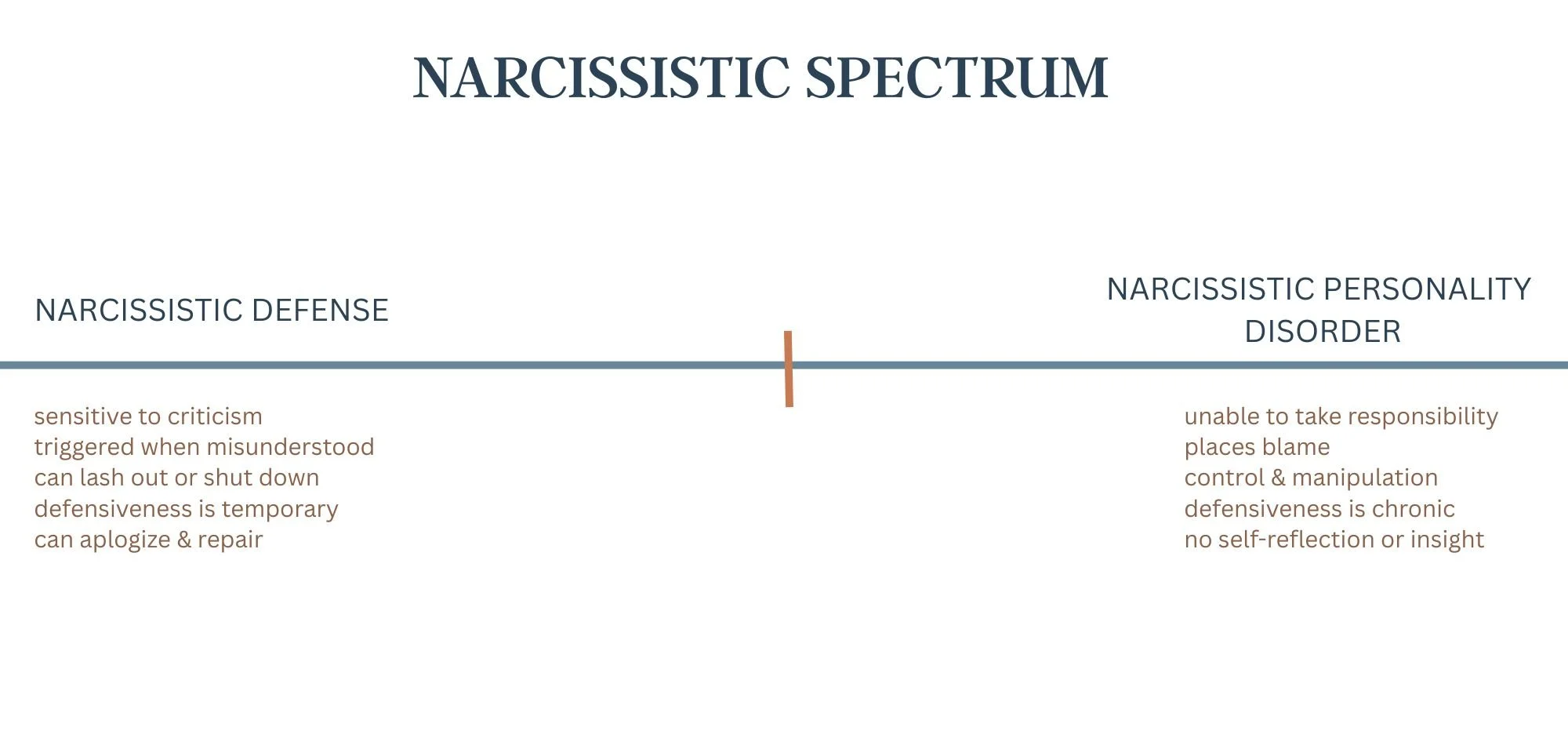
Spectrum of narcissistic traits & the difference between defense mechanisms vs Narcissistic Personality Disorder
If you grew up with a parent who leaned more towards the middle to Narcissistic Personality Disorder end of the spectrum, then here are a few things to know:
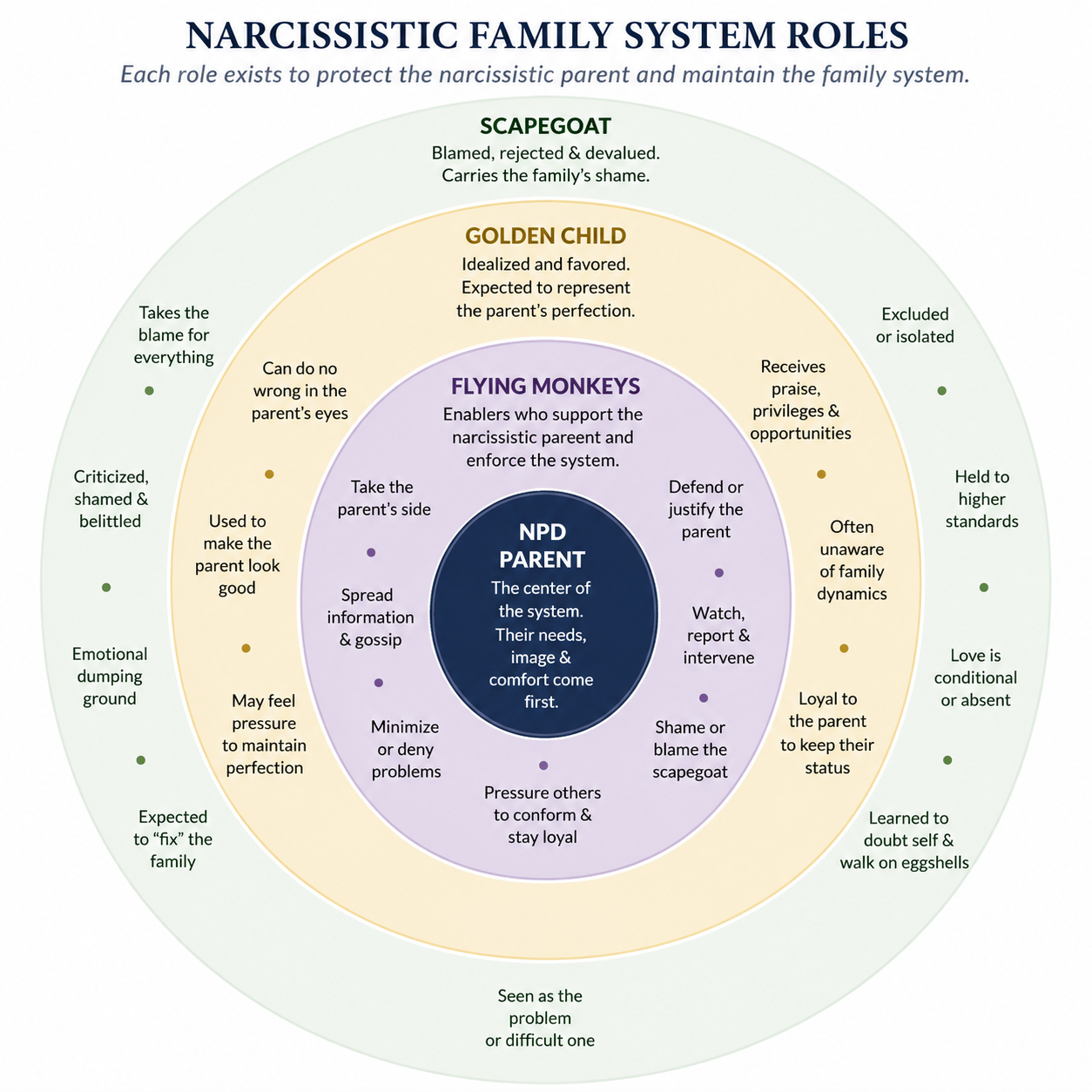
First, there are patterns that are so common in these family systems that all family members end up assigned to predictable roles
Second, none of the roles are good, but the one who takes the abuse most heavily is the scapegoat
Third, the scapegoats are usually the ones who come to therapy, get better, and move forward feeling less burdened
Why do narcissistic families need a scapegoat?
People often wonder… Why am I the black sheep? Why does my family make everything my fault?
In the quest to figure out a dynamic that seems to make no sense - they are, after all, working all the time to be good enough and do the right thing but never measuring up - they incorrectly determine it’s because something is wrong with them.
A better question is… Why do some dysfunctional family systems need a scapegoat?
Narcissistic personality structures develop through a combination of early life experiences, attachment disruptions, temperament, and other biological and environmental factors, and unresolved trauma and shame often play an important role. When one family member is unable to confront their own problems and messes in order to heal - whether it’s due to trauma, addiction, or their own internalized sense of shame - they project their feelings and experiences onto others so that they can avoid their own pain and maintain a sense of self. This is not usually a conscious process, and most people with this personality type do not see it or hope to change it. They keep placing the blame and burden on the people around them so that they don’t have to manage the pain that would come with addressing it.
The family scapegoat isn't usually the child who acted out or got into trouble. It’s often the child who questioned unhealthy behavior, spoke uncomfortable truths, set boundaries, or simply didn't fit the family role that had been assigned to them. The person who becomes the scapegoat is often the child whose strengths ironically make them more likely to occupy that role - sensitivity, intuition, compassion, and insight - because these qualities allow the pattern to perpetuate as they seek to self-reflect and change their behavior to try to fix the problem.
What people often say before they realize they were the family scapegoat…
Many family scapegoats don’t initially know they were scapegoated. They genuinely believe they are the problem, and if they can just figure out how to act better then they will finally be treated better… If I can do enough and be enough then people will treat me well.
Most family scapegoats don’t come to therapy saying they want help with being the scapegoat - instead they tend to come with high anxiety or frequent panic, constant worry and hypervigilance, intense self-doubt and a deep sense of inadequacy. They have often isolated themselves from close relationships because, on a deep level, they carry the belief they can’t have healthy relationships with others - relationships trigger anxiety, and it’s hard to believe somebody could truly care about and love them unconditionally when they believe they are fundamentally flawed.
They come into therapy saying things like…
I’m often intensely criticized in my family for what I feel, say, and do
My sibling is heavily favored
My family says everything is my fault
I'm too sensitive
I'm difficult
I’m a bad person
I feel guilty all the time
I struggle with a deep sense of shame
Nothing I do is ever enough
I feel responsible for everyone
I always feel like the problem
It’s also common that people who have been scapegoated come into therapy with skepticism and cynicism. They truly believe they’re bad and it can’t change. Because of their experiences, it can be hard to trust themselves or others. And that’s okay - in therapy I view skepticism as self-protective, and we work to understand it instead of trying to force you into any particular course of action.
Why being the family scapegoat can have a lasting trauma impact
Unhealthy family systems revolve around every member maintaining their roles, so living the scapegoat role out for a long period of time creates a core belief that there’s something wrong with me. What I usually see is that people who have been cast in this role have come to so deeply believe it’s true that everything is their fault, that it’s hard for them to consider a different reality. They have survived for so long by constantly anticipating the needs of others, adapting to their expectations, trying harder and harder to be good enough, and suppressing their own desires that it can actually feel threatening to break out of the cycle.
Over time, these experiences don't just remain isolated memories, they become the blueprint for how a person expects relationships to work. Many family scapegoats grow into adults who assume conflict must be their fault, struggle to trust their own perceptions, apologize excessively, tolerate unhealthy relationships, or feel responsible for everyone else's emotions. Even after leaving home, their nervous system often continues to respond as though they are still living in the same environment, expecting criticism, rejection, or blame.
This is one of the reasons the effects of being the family scapegoat can be so long-lasting. It's not simply remembering difficult experiences from childhood… it's carrying forward the beliefs and survival strategies those experiences created.
EMDR can help family scapegoats heal
Being the scapegoat isn't usually traumatic because of one big incident. It's the accumulation of repeated experiences that teach your nervous system that you're unsafe, unlovable, or fundamentally "the problem." EMDR targets the specific experiences that created those beliefs, allowing the brain to reprocess them so they no longer carry the same emotional weight.
I always say that out of all the roles in dysfunctional family systems, the scapegoat is the best one - because the scapegoat gets out. At some point they determine there’s nothing in it for them to stay in the same role - they recognize their tireless efforts to be good enough are never actually enough, and eventually they get exhausted. There’s no energy left to maintain the role so they are forced to re-evaluate. This is when therapy can help to gain a different perspective and heal deep wounds.
The upside of so many years of working to be better is that you develop several well-honed skills that help with growth and healing… insight, self-awareness, growth mindset, inner strength, and high capacity for self-improvement, to name a few. Usually the biggest struggle is coming to understand, believe, and accept that there isn’t something deeply flawed about you, and it was never your fault.
Because you were told the same negative story about yourself for so long, there is no amount of cognitive work or learning to think differently that is ever going to undo it completely. EMDR works differently than simply talking about these experiences. Rather than trying to convince yourself that you're worthy or that the past wasn't your fault, EMDR helps the brain reprocess the experiences that taught you those beliefs in the first place.
EMDR Intensives can be especially helpful for family scapegoats
The EMDR Intensive process can be such a relief for people because it allows us to get to a place of change and resolution in an accelerated period of time vs going to therapy for months or years to sort through these deeply ingrained family patterns. That said, it is not a fit for everyone because it requires a baseline of overall stability to engage in such deep and targeted work. In spite of having survived so much, people who have lived as the scapegoat in their family system often have a significant reserve of internal stability…
They have worked hard to self-reflect and uncover their blind spots and weaknesses
Ordinarily they have dedicated years to trying to understand and change their own patterns
They are well practiced in taking responsibility (expert level, after assuming responsibility not just for themselves but for everyone around them)
Self-reflection and insight are part of their daily lives
This means that there is already a foundation of work that has been done and insight gained, a general comfort level exploring difficult thoughts and feelings, and a significant drive to take the responsibility required to do the work of healing.
The Intensive process allows us to acknowledge that there are usually many interconnected memories reinforcing the same core belief that "I'm the problem,” and to dive deeply into memory networks that hold that belief so that it can be targeted and shift in new ways. Because the same belief system is often reinforced by many memories, the extended time available in an Intensive allows us to follow those connections while they're active rather than stopping after fifty minutes and picking them up again the following week. For people who have spent years minimizing or doubting themselves, staying immersed in the work rather than repeatedly "gearing up" week after week can reduce discomfort and increase integration in the process.
You can heal and move forward
If you grew up believing you were the problem, it's understandable that those beliefs still echo into adulthood. They weren't formed overnight, and they don't disappear simply because someone tells you they aren't true. The encouraging news is that these patterns can change. I've had the privilege of watching many people who spent years carrying the role of the family scapegoat begin to experience something entirely different - a growing sense of self-trust, healthier relationships, stronger boundaries, and the freedom that comes from no longer carrying blame that was never theirs to begin with.
