
Why Do I Always Feel Like I’m Not Good Enough?

EMDR Intensive Therapy in Colorado Springs
This post is part of my series, The Common Threads in EMDR Intensives, where I explore the patterns I see in the people who thrive in this format of therapy.
If you've spent years feeling like you're somehow less capable, less lovable, or less worthy than everyone around you, you're not alone. One of the most common beliefs I see in therapy is, "I'm not good enough." It often sits underneath anxiety, perfectionism, people-pleasing, chronic guilt, imposter syndrome, and relationship struggles. The good news is that this belief isn't something you're born with - it develops through experience, and it can change.
When You Always Feel “Not Good Enough”
This is an experience I have often in my office…
A person walks in believing “I’m Not Good Enough,” but appearing as though they have it all together. It could be a man or woman, older or younger, a parent or professional… this internalized belief just does not discriminate.
You usually wouldn’t know that the people who never feel good enough are working on overtime to bear up under the weight of this belief. They're often incredibly capable. They're the dependable employee. The parent who gives their all but never feels like it’s enough. The professional who has degrees, promotions, and accomplishments but still feels like they're fooled everyone into believing they're competent. The person who apologizes constantly. The one who can list twenty mistakes they made today but struggles to name one thing they did well.
But once we start talking, these are the things they share…
I feel overwhelmed by life
I’m unable to control my physical reactions to stress
I always feel on edge
I feel guilty about taking care of myself
I’m very quick to strong emotion
I’ve been living life in fight or flight for a long time
I worry all the time about anything and everything
I’m always waiting for the other shoe to drop
I often feel judged or not liked
I replay conversations for hours
I often feel like people are disappointed in me or upset with me
I overwork to prove myself
I struggle to say no
I feel like an imposter
If you can relate, you should know there’s usually a clear pattern in people’s histories that leads to this belief being so persistent and consuming. People often feel alone in this, as though they’re the only one and everyone else has an innate confidence that they are good enough, but this presents so often in my therapy sessions that I see a clear pattern between the belief and the underlying cause.
Where Does the “Never Good Enough” Belief Come From?
If you grew up with a shaming and critical parent, in a home where love was tied to performance, or with a family dynamic where emotions were neglected or criticized instead of nurtured, it is highly likely you carry a deep sense of “I’m not good enough.” What can be so confusing is that these aren’t always what we think of as “Big T Traumas,” those dramatic experiences that we expect to create a trauma response - but the ongoing nature of living in an environment that’s lacking in an ability to meet basic emotional needs still has a trauma impact.
We can compare this to the difference between jumping off a 10 meter diving board into an empty pool (a Big T Trauma with an obvious effect), and constantly swimming in a pool of toxic water (ongoing little t trauma). Both experiences have a significant impact, and sometimes the toxic water scenario is actually harder to unravel because it has seeped into everything for so long that it’s hard to separate what’s reality vs what has poisoned our perceptions and identity.
As children, we have to adapt to and learn to cope with what our parents offer because we’re completely dependent on them for survival. We have very limited options. Children who grow up with these family dynamics tend to manage the situation by always trying to be good, people pleasing, not letting anyone down, over-functioning, taking too much responsibility for the needs and feelings of others, and perfectionism because it’s never okay to make a mistake.
As you can imagine - or as you’ve experienced - this becomes exhausting after many years. The deep desire to feel more present, be more at ease, enjoy relationships without having to perform, and feel like it’s enough to just be without having to be what others want, is often what prompts people to start therapy.
How EMDR Helps Change Deeply Held Negative Beliefs
I often draw a spider web in sessions to illustrate how we work with and change memories in EMDR so that changes in identity and behavior can follow.
In the center is the belief, "I'm not good enough." Every strand connected to it represents another experience that reinforced that belief - a critical or angry parent, being parentified from a young age, growing up with an emotionally immature or addicted parent, humiliation or shaming for feelings, having to perform for love or approval, feeling responsible for everyone else's emotions, and so on...
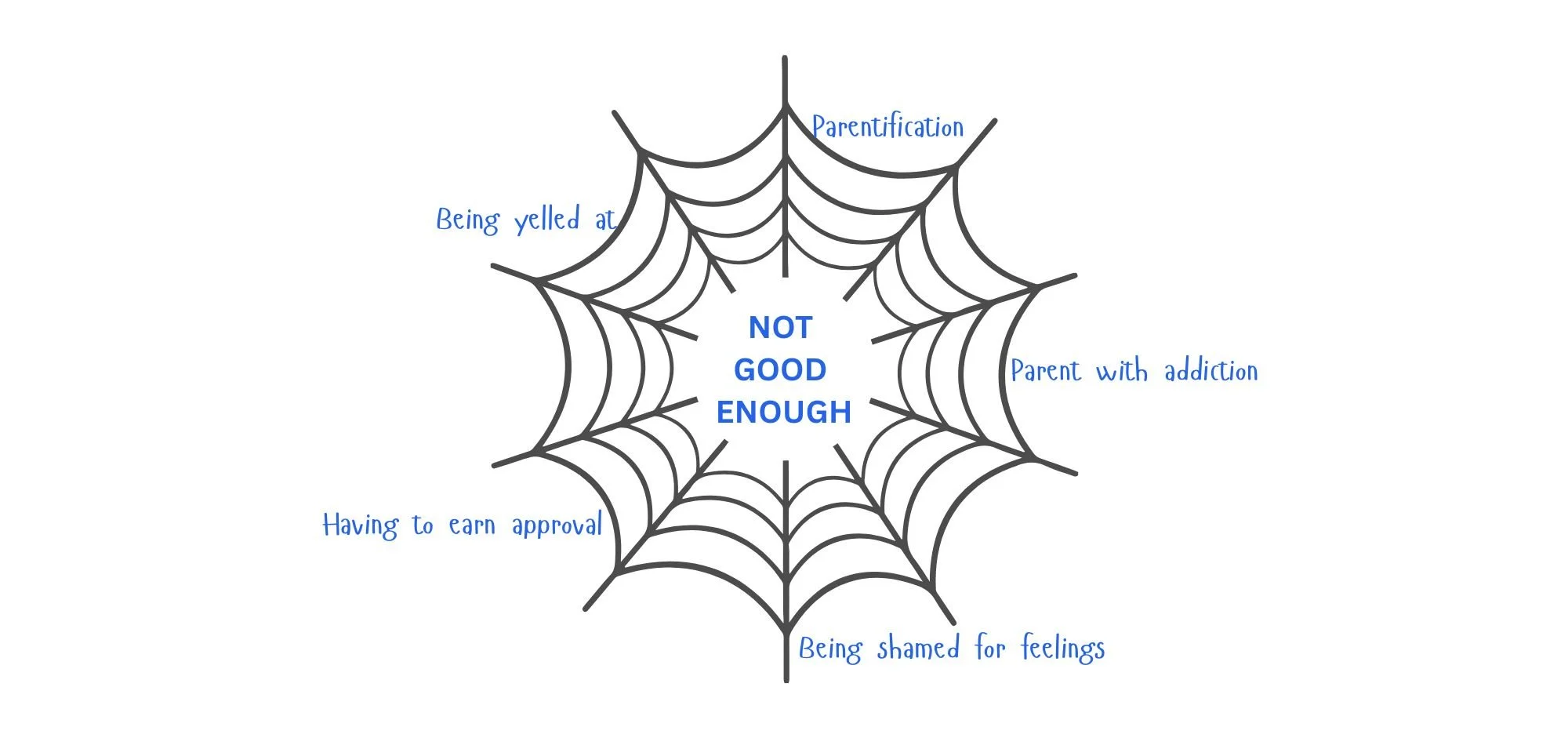
Trauma & the “Web of Lies”
In EMDR we start to unravel those strands by processing memories and beliefs until they feel neutral, just like other things you remember from the past. Because memories are networked together, each thing we process also touches into other “strands” of memory, creating a broader sense of resolution.

EMDR changes memory networks that hold negative beliefs
Strands continue to unravel through new experiences, positive relationships, and consistently using coping skills. More balanced beliefs and perspective have room to emerge…

More balanced, positive beliefs become stronger
I always say we can’t EMDR out your humanness - we all have insecurities and wounds that can flare up at times. But through EMDR, memories and negative beliefs soften enough that they stop feeling like constant evidence affirming your lack of value. Before EMDR, every painful memory feels like another exhibit in the courtroom proving "I'm not good enough." After processing, those same memories become experiences that happened - not proof of who you are.
After EMDR, people often experiences changes like…
They stop apologizing constantly
They become more appropriately assertive
They feel more confident in their feelings, decisions, and voice
They change unhealthy relationships
They allow themselves to make a mistake without beating themselves up
They shift out of constant people-pleasing
They feel more present and able to rest
They see themselves through a more realistic lens, with greater self-acceptance
People often wonder… But will this belief come back? When the underlying memories change, people usually aren't forcing themselves to think more positively. Instead, they naturally begin responding to themselves and the world differently because on a deep level, the belief no longer feels true.
How EMDR Intensives Help Untangle the "I'm Not Good Enough" Belief
Constantly feeling not good enough makes life feel very heavy. Relationships, work, hobbies, self-care - really everything - is impacted by the weight. Untangling this belief from your sense of identity removes burdens, brings clarity, and allows a sense of peace to become present. It’s hard to imagine that this can happen in the short-term format of Intensive therapy, but I often see certain clients experience tremendous relief, quickly, after a lifetime of never feeling enough.
The people who tend to benefit most from EMDR Intensives aren't looking for years of talking about why they feel this way. They're ready to understand where the belief came from, process the experiences that built it, and finally experience themselves differently. They often share these characteristics…
A comfortable relationship with emotions, and the ability to feel emotions without having to avoid or shut them down
A foundation of growth, and having done some of the work to resolve these beliefs already (either through self-help or past therapy)
A sense of insight around patterns, and what experiences have impacted them over time
One upside to the “not good enough” belief is that people who carry it are usually working very hard to get better. This means they come into the Intensive process with a solid history of self-reflecting and trying what they can find to do to heal. This gives us a foundation to build on that makes accelerated work possible.
Here’s what an intensive looks like for someone carrying this belief…
We’ll meet for a 60 minute intake session to review your history, and create a specific plan for what we’ll process to meet your goals - we don’t have to process your entire life (remember the web and how targeting one strand also reaches other strands?), we just need to pull out a handful of relevant memories that target where the belief is held
Before we ever process difficult or traumatic memories, we’ll meet for a pre-intensive preparation session so that you’ll know exactly how EMDR works and experience it with positive resources, memories, and experiences
We’ll meet for a series of extended processing sessions, usually two or three 3-hour sessions, to process the memories and triggers we identified in our plan - this is where the web unravels and change happens
After we’ve processed the targets in our plan, we’ll follow up in a post-intensive session to evaluate change, progress, and any remaining things that need to be addressed - at this point many people feel finished, and sometimes people find additional layers they’d like to process for greater resolution
The Intensive process is a commitment of time, money, and significant energy. I always want you to feel comfortable and confident before starting that this is the right fit for you. If you have questions, you can contact me for a consultation to find out how EMDR Intensives work, and if an Intensive is the right fit for your needs.
