
Trauma vs. Grief: Why Grief Often Surfaces as Trauma Heals

Trauma & EMDR Therapy in Colorado Springs
I’ve seen this pattern emerge for clients doing trauma work enough times to know that it’s a common part of the healing process…
As we work through past painful experiences with EMDR and the stuck images, engrained negative beliefs, and automatic responses are finally starting to shift, there’s a surge of emotion that feels surprising. Just as things are starting to feel better, more freed up, there’s a deep sense of pain, or a heavy weight of anger, or a sense of despair over not being able to change what happened that comes to the surface.
What often surprises people is that this is not a resurgence of trauma…
It’s the appearance of grief that never had an opportunity to be experienced and healed
Many people become worried at this point. They wonder if therapy is making them worse. In reality, it's often a sign that trauma is beginning to loosen its grip enough for grief to finally have room to be felt.
Trauma pushes you into survival mode, and when you’re in survival mode, the normal processes of your brain and body shut down. You need to be able to mobilize all of your energy towards just surviving the overwhelming experience. This means that things don’t get processed. Feelings get pushed to the background. Experiences become sort of frozen in time, stored in memory with all of the emotions and body sensations that were part of them when they happened.
When your brain is focused on surviving, it doesn't have the capacity to fully experience the losses that happened alongside the trauma. Those losses are still there… they're simply waiting until your nervous system has enough safety to process them.
With EMDR we’re able to target the distress attached to traumatic memories and experiences. We change the stuck images, negative beliefs, emotions, and body sensations that keep them alive in the present even though they happened in the past. Part of the EMDR process is tracking the level of distress connected to a memory as we process it, so we can consistently know that it’s changing. Usually it’s when things are getting to the least distressing point that the grief makes an appearance.
When I ask to go back to the picture of the memory and tune into the emotions, beliefs, and body sensations attached to it, the response is that there really aren’t anymore. When I describe distress as the feelings of the event being present in the moment, the report is that there is no longer distress connected to it - it just feels neutral.
And yet, there are tears, or strong feelings, showing up in a new way.
This is when we know it’s grief and not trauma
It’s so important to be able to separate grief from trauma because they require different responses. Trauma keeps the past feeling present. Grief recognizes the loss happened in the past, but still hurts in the present.
Trauma is the sense that what happened in the past is alive in the present. No matter how much time passes, or how much processing is attempted, it never truly seems to change, it may feel like it just loops over and over. Trauma responses can show up as persistent anxiety, feeling disconnected from the present, nightmares, flashbacks, triggers, strong reactions, a disproportionate negative view of self, and a sense of being out of control of your reactions.
Grief is the presence of strong emotion connected to a loss. Grief usually feels like waves of different intense emotions that come over and over, like sadness, anger, guilt, numbness, and depression - the feelings build up and get bigger, come to a peak, and then wash away for a period of time until the next wave comes. Often the grief isn't about the traumatic event itself, it's grief for what the trauma took away - a sense of safety, years of life spent surviving, relationships, opportunities, or the childhood someone should have had. With grief, even though the emotions can feel very intense, they change - as they are felt and processed, they continually evolve, becoming less intense and less frequent over time.
Revisiting and feeling the emotions connected to trauma doesn’t ordinarily tend to help because those memories are stored with the same feelings and body sensations you experienced at the time they happened. The more you think about it, the more distress rises. But processing the feelings connected to grief can change them - grief needs to be felt to be relieved.
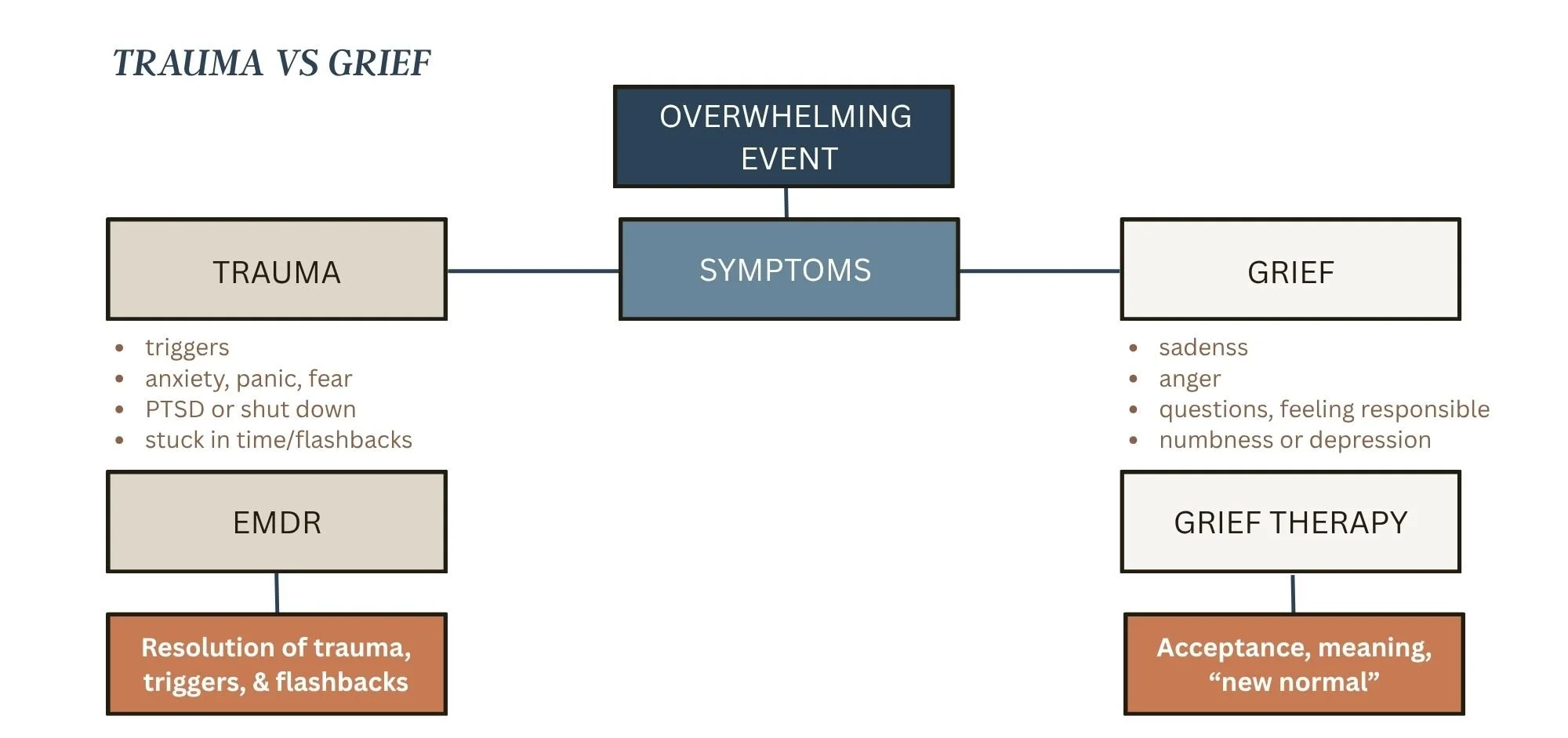
What is the Difference Between Grief & Trauma?
You can see how confusing and overwhelming it can feel when trauma and grief are all muddled up together, feeling like one big ball of gunk.
In therapy, we gently separate grief from trauma, and treat them individually in the ways that are most effective
If you're doing trauma therapy and suddenly find yourself crying more, feeling sadness you didn't expect, or grieving losses that seem like they should have been resolved years ago, it doesn't necessarily mean you're getting worse. It may actually mean your nervous system is no longer working so hard to survive.
That's one of the remarkable things about healing. As trauma begins to release, it often creates space for grief that couldn't be felt before.
Grief is painful, but unlike trauma, it moves, it changes. As it is experienced, it gradually becomes less overwhelming, less consuming, and less frequent.
Healing isn't about never feeling pain again. Sometimes it's about finally having enough safety to feel the pain that has been waiting all along, and rediscovering hope that it doesn't stay the same forever.
For trauma therapy in Colorado, contact me for a free consultation
Grief & Trama FAQ
Why do I feel worse after EMDR?
Sometimes people experience grief after trauma begins to heal. This doesn't necessarily mean therapy is making things worse. As the nervous system becomes less focused on survival, emotions that were previously inaccessible can finally be experienced and processed.
What is the difference between trauma and grief?
Trauma keeps the past feeling present through distress, triggers, and survival responses. Grief is a natural response to loss. Although grief can feel intense, it changes over time as it is experienced.
Can grief appear years after trauma?
Yes. Many people don't have the emotional capacity to process grief while they are surviving trauma. As healing progresses, grief may emerge for the first time, even years later.
Is crying more during trauma therapy normal?
For many people, yes. Increased emotion isn't always a sign that therapy is making things worse. It can be a sign that trauma is beginning to resolve, allowing grief and other emotions to surface.
